

GPC Operations Cell: gpc[at]unhcr.org
Gender-Based Violence: chase[at]unfpa.org
Child Protection: rpouwels[at]unicef.org
Housing, Land and Property: jim.robinson[at]nrc.no
Mine Action: unmasgeneva[at]un.org

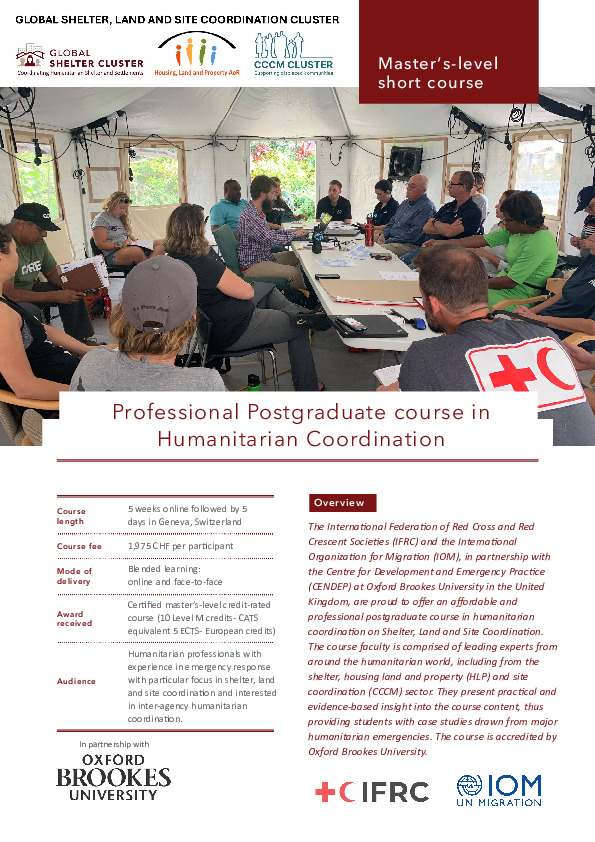
This master’s-level short course in Humanitarian Coordination, from the newly formed Global Shelter, Land and Site Coordination (SLSC) Cluster is a flagship training, offered by the International Federation of Red Cross and Red Crescent Societies (IFRC) and the International Organization for Migration (IOM) in partnership with the Centre for Development and Emergency Practice (CENDEP) at Oxford Brookes University.
This course draws upon IFRC’s and IOM's role in its new leadership under the humanitarian reset for the Global Shelter, Land and Site Coordination (SLSC) Cluster. This new Global Cluster reflects one integrated global platform bringing together the existing mandates and functions of the Shelter, CCCM, and Housing, Land and Property (HLP) into a placed-based, people-centered model. It builds upon the inter-agency mechanism to coordinate humanitarian shelter, housing land and property, and site management sectors in both preparedness and response situations The course aims to equip participants with the skills required to coordinate a humanitarian response in a crisis caused by disasters, conflicts, or a combination of both. It provides participants with an overview of the humanitarian reform process and the recent humanitarian reset, the inter-agency cluster approach, the role of the SLSC Cluster and the principles and practice of coordination in emergencies.
At the end of the course, participants will have acquired strategic and practical knowledge of the SLSC Cluster, policies, methods, tools, and procedures in the humanitarian response system and are prepared to apply these in the context of a humanitarian crisis.
Tuition Awards
In memory of Graham Saunders, former Global Shelter Cluster Coordinator, the IFRC will support one participant by covering the course fee. Those willing to benefit from this opportunity must indicate so in the online application form. The criteria for selection include number of years of experience, cluster experience and languages. Nationals from less-developed countries and staff or volunteers from the Red Cross Red Crescent Movement will be prioritized.
Course Outline
This course covers the following topics will be delivered through the online and face-to-face components:
Period of Study
The course has two phases:
Practical Information
Who can apply?
Individuals working in the humanitarian and shelter sectors for the Red Cross and Red Crescent Movement, United Nations agencies, non-governmental agencies, governments, in particular agencies or institutions actively involved in the inter-agency shelter coordination at the global or country levels. The course is also open to individuals seeking to advance their understanding of and expertise in the field of inter-agency, humanitarian coordination.
How to apply?
Applications are accepted through this link.To complete your application please send your CV to [email protected]. Applications without CVs will not be considered. Applications for the course should be submitted before midnight (GMT+1) on 28 February 2026 with an agreement of your employer (reference) if this applies to you.
Language of instruction
The language of instruction is English.
Fees
The fees are 1,975 CHF (Swiss francs) per participant. It does not include any costs related to accommodation and travel for the face-to-face workshop. The fees are due once you have been accepted to the course.
Credits awarded
Certified master’s-level credit rated course by Oxford Brookes University (10 UK master’s-level credits- CATS, equivalent to 5 European master’s-level credits- ECTS)
More information
If you have a specific enquiry, please address it to [email protected] and your query will be forwarded to the most appropriate person. Please also consult the available course flyer.