

This page provides key information and resources for country Protection Clusters, protection partners, donors and other partners on the Humanitarian Reset and its implications for Protection - both as a specialized sector and a collective commitment across humanitarian action.
This page particularly focuses on four key issues related to the Humanitarian Reset:
- Ensuring that Protection remains prioritized throughout the Humanitarian Reset implementation
- Cluster simplification and the consolidation of the Protection Cluster and its former Areas of Responsibility for Child Protection, Gender-Based Violence and Mine Action
- Accelerated transitions out of the humanitarian system
- The Humanitarian Reset and foreign aid funding cuts' impact on protection capacities
About the Humanitarian Reset
1. PROTECTION AT THE CENTRE: ENSURING Protection is and remains a Priority in Humanitarian Action
Most humanitarian crises are protection crises, even if not acknowledged as such. Violations of international law and patterns of abuse, violence, coercion, deliberate deprivation, exploitation, and exclusion are often the drivers of other humanitarian needs, and further exacerbate them. Failing to adequately consider protection in emergency interventions is detrimental to the entire humanitarian response and, ultimately, affected populations.
With the Humanitarian Reset calling for increased efficiencies and hyper-prioritized humanitarian response plans and action that put protection at their centre, the GPC together with country Protection Clusters, protection partners and allies continuously engages with OCHA, Humanitarian Leadership, Donors and other key stakeholders to ensure that Protection - both as a specialized sector and as a collective commitment, in line with the 2016 IASC Protection Policy - remains a priority, not only in theory but in practice, across humanitarian action.
To this end, the GPC published a global statement and key advocacy messages to recall why Protection matters and it is both life-saving and a central element to longer-term solutions. Several country Protection Clusters developed context-specific advocacy messages with GPC support, including in Ethiopia, Mozambique and South Sudan.
The GPC also develop a dedicated guidance for country Protection Clusters to navigate in-country (hyper)prioritisation efforts.
2. Cluster Simplification: Consolidation of the Protection Cluster
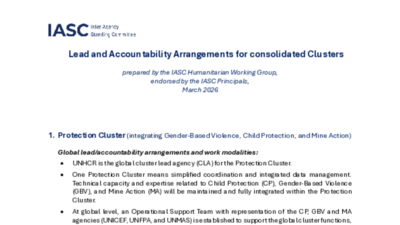
As part of the Humanitarian Reset, the Protection Cluster and its former Areas of Responsibility (AoR) - Child Protection, Gender-Based Violence and Mine Action - integrate into one single, consolidated Protection Cluster. The former Housing, Land and Property Area of Responsibility is moving to the newly established and consolidated Shelter, Land and Site Coordination Cluster, while still keeping strong operational and strategic linkages with the Protection Cluster.
This processed has been formalized by the IASC Principals, including by the release of related guidance in March 2026.
As of February 2026, the Global Protection Cluster and the former Global AoRs are now consolidated into one global team. The GPC is also providing constant support to country Protection Clusters in implementing the consolidation process, including through the development of complementary guidance and remote and in-country support.
3. ACCELERATED Cluster Transitions
In line with the Humanitarian Reset's objective to better embed resilience and planned exits from day one, and supports accelerated transitions, several country Protection Clusters will undergo (accelerated) transition processes. As per decision of the IASC in 2025, Protection Clusters in Cameroon, Colombia and Nigeria are currently in the process of transitioning.
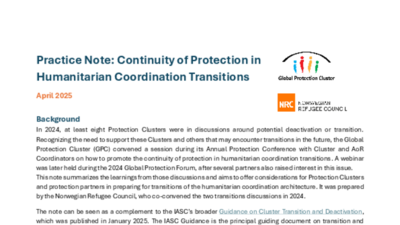
Across contexts, Protection Clusters must adapt their coordination mechanisms to ensure continuity of critical services, and that coordination is in line with the operational needs of our partners. In this context, in 2025, the GPC together with NRC developed a Note on Protection in Humanitarian Coordination Transitions to support Protection Clusters and partners to prepare for and undergo transition processes. This note complements the IASC Guidance on Cluster Transition and Deactivation.
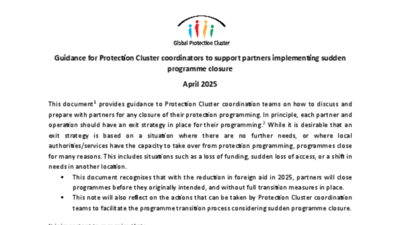
In addition, reforms and and significant cuts to foreign aid funding have pushed protection clusters and their partners to navigate complex transitions and potential program closures. These shifts require careful planning to minimize disruptions to affected populations and ensure that critical protection services remain accessible where possible. In order to support Protection Cluster coordination teams on how to engage partners in structured discussions for any closure of their protection programming, the GPC developed a Guidance on Sudden Programme Closure.
4. Protection funding and capacities in the midst of the HUMANITARIAN RESET and foreign aid FUNDING CUTS
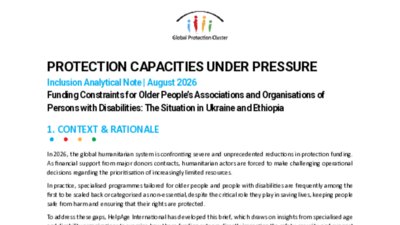
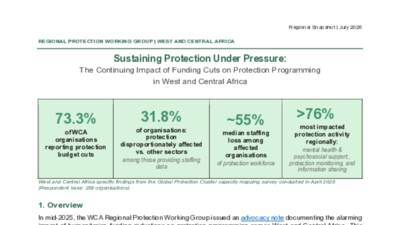
In the context of the Humanitarian Reset and reductions in foreign aid funding to support humanitarian responses, the GPC is engaging proactively with humanitarian leadership, donors and partners to assess trends in protection funding, capacities and responses and advocate accordingly.
Following a 2025 predictive analysis, the GPC conducted extensive consultations with 22 country Protection Clusters and protection partners in 2026 to assess impact on protection capacities across humanitarian crisis contexts.
The GPC is also monitoring changes in the funding context for humanitarian responses, supporting country Protection Clusters to adapt accordingly, and engaging with all relevant donors. As part of its core mandate, the GPC continues to follow the planning and disbursement of funds through mechanisms like the country-based pooled funds, including allocations relating to the recent US Awards to OCHA.

.jpg)

Support Materials
- Ethiopia Protection Cluster Advocacy Messages - Protection Interventions as Lifesaving and in Support of Stability and Solutions
- South Sudan Protection Cluster - Key Messages on Protection
- Mozambique Protection Cluster - Protection in Emergencies is Critical and Lifesaving
- OCHA - Collective Messages on the Suspension of Humanitarian Assistance – Information for Communities and Affected People