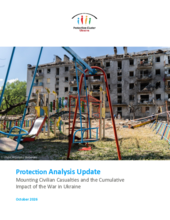
Entering the fifth year of the full-scale war, Ukraine’s civilian population continues to experience the cumulative effects of prolonged and increasingly technology-driven warfare, characterized by persistent insecurity, repeated displacement, and widespread damage to civilian infrastructure. With no clear end to the war in sight, the war is deepening protection risks, entrenching vulnerabilities and prolonging people’s humanitarian needs, even for those who have been displaced to relative safety. The Protection Cluster notes with concern the increasing lethality of attacks, particularly along the frontlines and in large urban centers, due to the type and quantity of weapons used and the increased range of drones. This is driving a trend of steadily rising civilian casualties, including the staff of partner organizations. Since the start of 2026, Russian armed forces have intensified attacks on civilians and civilian infrastructure, including in major cities including Kyiv. Across Ukraine there are daily attacks, continuous air raid alerts, and growing damage to critical infrastructure and energy facilities. Civilian casualties in 2026 have been higher than during the same period in any year after 2022. In July 2026 there were 437 verified cases of civilians killed and 2,610 injured, including 183 casualties among children (killed and injured), the highest number since May 2022. In the most exposed areas of Donetska and Zaporizka oblasts, intensifying attacks are increasingly pushing aspects of civilian life into basements, shelters and other protected underground spaces, replicating patterns already observed in Kherson city (more in Annex 1). During the winter 2025-26, the attacks on civilian infrastructure, particularly energy supplies and transport infrastructure, desperately exposed people to the brutal cold and isolation. Given the protracted nature of the conflict, the Government of Ukraine strengthened its legislative and policy framework to strengthen coordination and response to IDPs, issuing a National Strategy on Internal Displacement and the updating of the national evacuation framework.
This report is the fourth Ukraine Protection Analysis Update (PAU), covering the period September 2025 - September 2026. The Protection Cluster emphasises the increasingly complex protection impact and strain of the five key risks highlighted in the report, while their severity, geographic reach and cumulative impact have intensified in several areas. The PAU highlights the effects of the war on the cross-section of Ukrainian society, including women, men, children and minority communities including the LGBTIQ+ and Roma community. Protection actors continue to advocate for a people-centered approach to humanitarian action. This approach supports affected people to address the protection risks they face where they are, based on their individual circumstances rather than rigid criteria, prioritizing service provision, and reducing barriers to access durable solutions from the outset of humanitarian response.
The Protection risks requiring immediate attention in the period covered by this analysis are:
- Attacks on Civilians and Civilian Objects.
- Forced Displacement, Restrictions to Freedom of Movement and Returns in Adverse Conditions.
- Gender-Based Violence.
- Impediments and Restrictions to Access to Legal Identity, Remedies and Justice, including Housing Land and Property Rights.
- Presence of Explosive Ordnance.
Annexes:
The “Khersonification” of Donetska and Zaporizka Oblasts | Global Protection Cluster
Transit Center Evacuation Trends in Ukraine – January – August 2026 | Global Protection Cluster