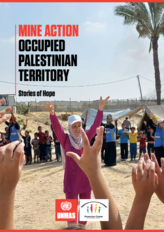
Over the past two and a half years, explosive ordnance contamination across the Occupied Palestinian Territory has proliferated. In Gaza, although unable to assess all areas of the Strip, partners have encountered over 1,000 dangerous items while carrying out their daily missions. Meanwhile in the West Bank, the Palestinian Authority identified 255 explosive ordnance items in the first four months of 2026, already surpassing the total found in all of 2023.
Aside from the threat to life and limb, the presence of explosive ordnance shrinks the already restricted space available for humanitarian and civilian activities.Even the potential presence of explosive ordnance restricts the space that people can use for livelihood activities, stalls humanitarian delivery, and makes everyday activities – like collecting firewood, setting up shelters, or going to the market – more dangerous.
Since the escalation of hostilities in October 2023, humanitarian mine action partners have worked with communities and humanitarian partners to minimize the impact of explosive ordnance contamination. By teaching communities and humanitarian personnel about explosive threats, assessing places and roads for these threats, and supporting people who have been injured by ordnance and their families, the sector aims to support people to navigate explosive threats more safely.
There is still much to be done. Contamination remains extensive, with dangerous items continuing to be found on roads, in shelters, or buried among debris. Addressing this is a key hurdle to safe and sustainable development and, eventually, peace in Gaza and the West Bank. The mine action sector will continue working with partners to expand the response and advocate for the critical equipment and clearances needed to dispose of ordnance, with the goal of eliminating threats altogether for communities. In the meantime, we continue to support community safety, facilitate humanitarian delivery and
enable safe early recovery efforts.
Behind this stark context lie human lives caught in the balance. The following pages share the stories of communities, humanitarians, and youth leaders who are reclaiming their futures. They offer a glimpse into how mine action goes beyond technical assessments, playing a critical enabling role for humanitarian, early recovery and civilian interventions.