

About the Issue
Protection of all persons affected and at risk must inform humanitarian decision-making and response, including engagement with States and non-State parties to conflict. It must be central to our preparedness efforts, as part of immediate and life-saving activities, and throughout the duration of humanitarian response and beyond. In practical terms, this means identifying who is at risk, how and why, taking into account the specific vulnerabilities that underlie these risks, including those experienced by men, women, girls and boys, and groups such as internally displaced persons, older persons, persons with disabilities, and persons belonging to sexual and other minorities.
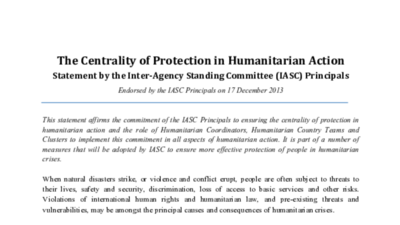
In a Statement issued in December 2013, the Principals of the Inter-Agency Standing Committee (IASC) affirmed that all humanitarian actors have a responsibility to place protection at the center of humanitarian action. The IASC has committed to a systemwide and comprehensive response to conflict and disasters. This response is driven by the needs and perspectives of affected persons, with protection at its core.
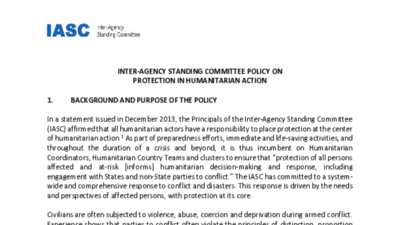
In October 2016, the Inter-Agency Standing Committee (IASC) adopted its Policy on Protection in Humanitarian Action. The policy defines the Centrality of Protection in humanitarian action, as well as the process for its implementation at country level. In doing so, it seeks to reinforce complementary roles, mandates and expertise of all relevant actors.
Six key elements
- The Humanitarian Coordinator (HC) is responsible for leading and coordinating a humanitarian response that is principled, timely, effective and efficient, and contributes to the reduction and mitigation of protection risks. The HC has a fundamental role to play in ensuring that protection informs decision-making and that protection priorities are identified and result in collective action.
- The HCT must commit to share information and analysis on protection as well as to prioritize and contribute to collective efforts to enhance protection for affected persons, in accordance with each member’s expertise and mandate.
- Humanitarian actors should address protection risks that intersect with their formal mandates and sector-specific responsibilities. This includes protection mainstreaming, protection integration and specialized protection activities.
- Humanitarian actors must engage collectively to achieve meaningful protection outcomes that reduce risks to affected persons by decreasing threats, reducing vulnerability, and enhancing capacities. At country level, the development of a HCT Protection Strategy, or equivalent framework, must focus on addressing critical protection risks, and prompt collective action in complement to the Humanitarian Needs and Response Plan and the Protection Cluster strategy.
- The HC and HCT must mobilize other actors within and beyond the humanitarian system to contribute to collective protection outcomes. Addressing protection risks often goes beyond the capacity of the humanitarian community which requires engagement and advocacy with a broad range of stakeholders beyond the humanitarian response.
- Humanitarian actors must evaluate commitments and progress towards placing protection at the center of the humanitarian response. The HCT must regularly monitor and evaluate its progress in working collectively to achieve protection outcomes and reducing the exposure of affected persons to risks and violations.
Centrality of Protection Video
Support Materials
- IASC Policy on Protection in Humanitarian Action - Aide Memoire
- IASC Benchmarks for HCT Centrality of Protection Implementation
- The Centrality of Protection: Questions and Answers
- The Centrality of Protection: Practical Steps for Humanitarian Coordinators and Humanitarian Country Teams
- GPC Provisional Guidance Note on HCT Protection Strategy
- Centrality of Protection in Humanitarian Action 2022 Review
- Centrality of Protection in Humanitarian Action 2018 Review
- Centrality of Protection in Humanitarian Action 2016 Review
- Centrality of Protection in Humanitarian Action 2017 Review
- Centrality of Protection in Humanitarian Action 2019 Review
- Centrality of Protection in Humanitarian Action 2020 Review
